How a Top 20 Bank Transformed Payments Into a Strategic Advantage
Introduction
The bank is one of the nation’s largest auto finance companies, serving more than three million customers across the full credit spectrum. The bank has a straightforward business model: lend money and make it easy—and reliable—for borrowers to pay it back.
But behind that simplicity lies an operational reality shared by many large financial institutions: payments infrastructure is complex, carries significant risk and directly affects customer experience, operating costs and agent effectiveness.
The bank needed to rethink how payments worked across the organization.
The challenge: Reliability, scale and the true cost of payments
What motivated the bank to explore a new payments platform?
Its legacy payments solution had become a constraint rather than an enabler. As the bank scaled, the need to modernize its payments infrastructure became increasingly urgent.
Top pain points identified during discovery included:
- Payment reliability and uptime: Outages and service disruptions created immediate customer impact and downstream operational burden
- Agent productivity: Too many payments required manual intervention, pulling agents into low-value tasks instead of higher-impact work
- Borrower experience: Limited self-service options and fragmented payment flows increased abandonment, late payments and call center volume
- Rising total cost of acceptance: Returns, chargebacks, exceptions and manual reconciliation were driving up costs well beyond transaction fees
Why PayNearMe: A platform for payment experience management
What factors made PayNearMe stand out?
The bank evaluated multiple options, but PayNearMe differentiated itself by aligning technology with business outcomes.
Key buying criteria included:
- PayNearMe Smart Link™ technology to enable personalized, one-click, self-service payments without a login
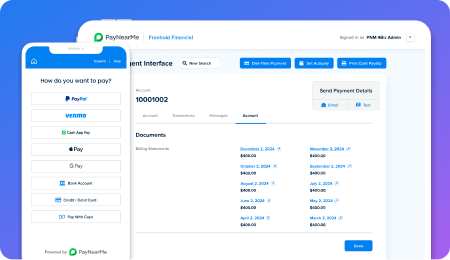
- Broad tender support including ACH, debit, Cash App Pay, Apple Pay, Google Pay, PayPal, Venmo and cash
- Agent tools that reduce friction and surface better payment context
- Proven reliability and uptime
- Configurability and extensibility to support future use cases
Like any major payments transformation, the project came with risk. The bank’s initial concerns centered on change management across teams and channels, as well as implementation complexity and cutover risk.
The turning point came when the bank aligned stakeholders around a shared set of goals: reducing exceptions, increasing self-service and lowering the total cost of payment acceptance—without sacrificing customer experience.
Performance: Measurable gains across cost, experience, and efficiency
Within months of launch, the bank began seeing meaningful improvements in both customer adoption and operational performance.
Self-service and digital adoption
- 96% of PayNearMe payments flow through self-service channels
- 2% increase in self-service adoption drove $1.85M in savings
- 5% increase in AutoPay enrollment within the first six months
- AutoPay growth contributed to $800K in annualized savings
Reduced exceptions and payment failures
- ACH return rate decreased by 1%
- Chargeback rate decreased by 0.02%
Together, these improvements generated nearly $850K in savings.
Tender mix optimization
- ACH: 60%
- Debit Card: 30%
- Apple Pay: 9%
- Google Pay / Venmo / PayPal / Cash: 1%
This intentional shift toward lower-cost, more reliable payment methods helped the bank reduce risk while meeting borrower preferences.
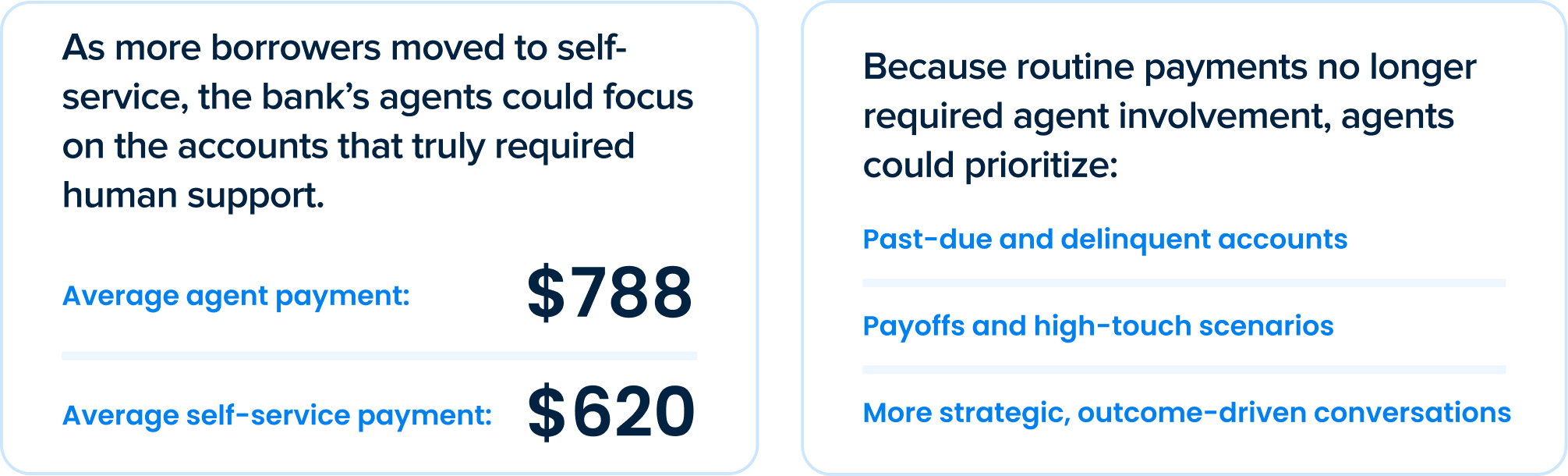
Elevating agents by removing low-value work
One of the most impactful outcomes wasn’t just customer-facing—it was internal.
Rethinking the total cost of acceptance
The bank approached modernization through a broader lens: total cost of acceptance and Payment Experience Management.
Rather than focusing solely on transaction fees, the bank evaluated:
- Manual exception handling
- Call center labor
- Returns and chargebacks
- Reconciliation and reporting effort
- Late and missed payments
- Training and system overhead
By reducing exceptions and increasing straight-through processing, PayNearMe helped the bank systematically drive these costs down.
Customer and team feedback
The bank used targeted SMS campaigns with Smart Links to help customers transition to the new payment experience.
The bank’s teams report greater ease of use across both consumer and agent experiences.

Borrowers
Borrowers respond positively to one-click Smart Links and expanded payment choice

Agents
Agents benefit from fewer system handoffs and clearer payment context

Operations
Operations teams see faster reconciliation and fewer support tickets
A model for modern payment experience management
This bank’s partnership with PayNearMe demonstrates what’s possible when financial institutions treat payments as a core business capability.
By prioritizing reliability, self-service and agent effectiveness, the bank has made payments a more strategic part of the business, creating better experiences for borrowers and agents while improving outcomes for its back-office operations team.