Passing the Torch: Reflecting on Michael Tibbott’s Impact at PayNearMe
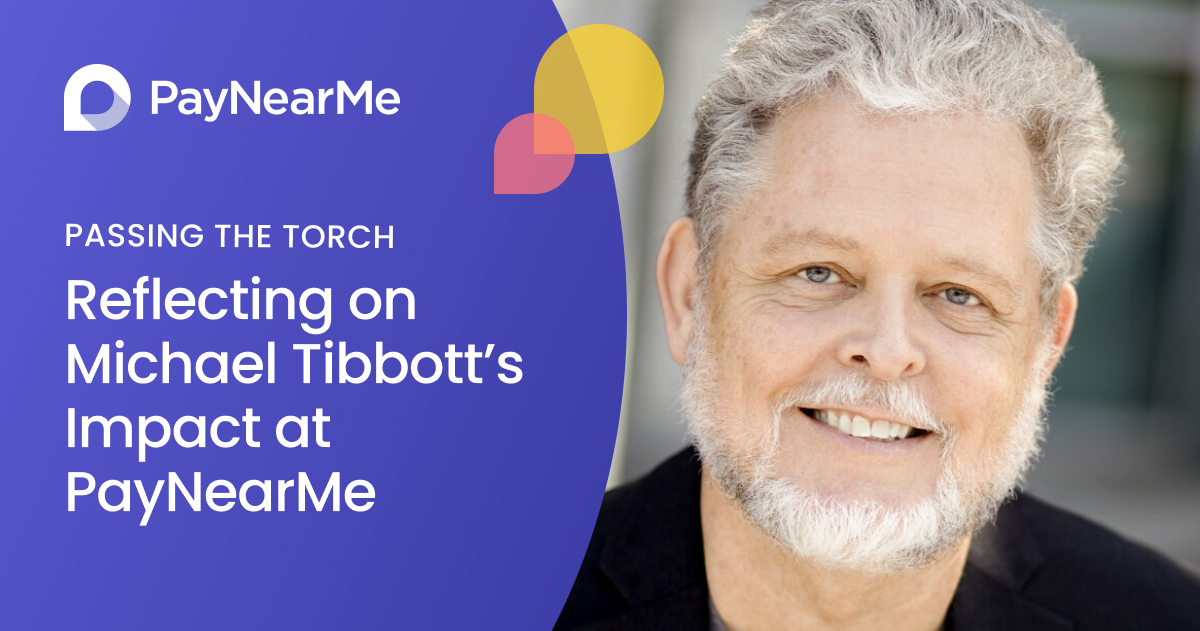
When people talk about the history of PayNearMe, Michael Tibbott’s name is impossible to separate from the story. One of the company’s earliest employees, Michael has spent the last 16 years helping build the technical foundation of the business, and just as importantly: the culture behind it. As the longtime leader of engineering, he has guided the team through pivotal moments of growth, transformation and innovation, always with a deep belief that the work matters because it impacts real people—our clients and their customers.
Now, as he steps down from leading the engineering organization and begins passing the torch, it’s a fitting moment to reflect on his impact. Michael’s career has taken him from pioneering hardware and early mobile technology to internet startups bridging Hollywood and Silicon Valley, but at PayNearMe he found the rare opportunity to help build something enduring. His influence can be seen in the strength of the platform, the leadership bench he helped develop and the values that continue to guide the team today.
In this retrospective, Michael looks back on the early days, the turning points that shaped the company and the lessons he hopes will carry forward into PayNearMe’s next chapter.
The Early Days: Scrappy, Fast and Focused
Q: You’ve been at PayNearMe since the beginning. What do you remember most about those early days?
Michael Tibbott: What stands out most is just how small and scrappy we were. When I joined, there were only three people in engineering, and we were under a really tight deadline to ship the first product in about a month. In those early days, everyone did whatever needed to be done. Titles didn’t matter. We were just trying to ship great products that helped our clients.
My role wasn’t just technical. Sometimes it was helping absorb requests to keep the team focused so the people building could keep building. It was intense, fast-moving and very hands-on, and that set the tone for a lot of what came after.
Q: What originally drew you to join the company, and what made you stay?
MT: Steve Capps, PayNearMe Chief Innovator and PayNearMe Fellow, introduced me to the company, but I joined because of our CEO, Danny Shader. I asked Capps, “Why this company?” and he told me Danny was such a strong founder that he wanted to work with him again after this one succeeded. I’ve always believed that a strong CEO is one of the best predictors of success, and that was a big reason I joined the company. What made me stay was that the company kept evolving. It never stood still. There was always a new challenge, a new phase of growth and something meaningful to build.
Michael was contributing to PayNearMe years before he was ever on payroll. We’d meet for lunch every week, and he’d give me advice that I would code that night. Eventually it got to the point where he might as well be paid, instead of working through me, so he became the third engineer. Unlike us, he actually had real-world experience running web applications so he quickly assumed a much broader role and has held it ever since.
Steve Capps, Chief Innovator and PayNearMe Fellow
Q: When you think back to the very beginning, did you have a sense of what the company could become?
MT: Not at all. In the early days, we built the first proprietary cash network that enabled businesses to accept cash payments from their customers at retail locations. The system later evolved into a full payment experience management platform. The company and our technology has changed dramatically over the years. None of us could have predicted that path. That constant evolution is part of what made it so interesting to stick around.
Every Payment Matters
Q: You helped build the company’s first products, including the cash product. What were some of the biggest challenges in those early builds?
MT: In the beginning, everything moved fast and we were incredibly focused on reliability. You don’t usually think of software development as standing in line at a 7-Eleven at midnight, but that’s exactly what we did. We’d release code and then go test it in the real world.
Those moments made it clear that what we were building wasn’t abstract. Real people were depending on those payments to go through successfully. That’s where the mindset came from: every payment matters.
Q: What are you most proud of when you look at the PayXMTM platform today?
MT: I’m proud of how reliable our platform is, but more than that, I’m proud of the culture behind that reliability. We take every payment seriously because we know it impacts real people. If a payment fails because of something we did, that can affect someone’s life in a meaningful way. That’s why we hold ourselves to such a high standard.
We’re tough on ourselves, but that’s part of why the platform performs the way it does. The technology matters, but the mindset behind it is what makes the difference.
Our focus has always been simple: solve meaningful problems to deliver a payment experience our clients can depend on. Michael has played a critical role in bringing that to life. His dedication to PayNearMe and to our clients over the years has had a lasting impact, and we are all grateful for everything he’s contributed.
Danny Shader, CEO
Q: How would you describe PayNearMe’s engineering philosophy, and the role Product Management plays in it?
MT: Product is critical. One of the things I learned early, especially from my time at Apple, is how important strong Product Management leadership is. At PayNearMe, Product and Engineering operate as true partners. Product defines what we should build, and Engineering figures out how to build it well.
If I had to sum up our engineering philosophy, it’s this: every payment matters, so we must build with care and partner deeply with Product. We take quality seriously, move with purpose, and focus on solving important problems for our clients.
Q: You’ve seen the company evolve over many years. What moments stand out as true turning points?
MT: There were a few moments where things really clicked. Early on, we realized we had true 24/7 transaction volume—that payments were happening constantly and people were depending on us around the clock. That changed how we thought about reliability.
Another big shift came when clients who originally came to us to help them accept cash payments started asking us to handle their electronic payments because they trusted us. That was the bridge from being a cash-only business to becoming a broader payments company. And during COVID, because we had already embraced remote work, we were able to adapt quickly. That period really reinforced how strong the team was.
Q: How has the engineering team changed from the early days to now?
MT: In the early days, it was a small team moving fast with very little structure. Today, it’s a much more mature organization with strong leaders and deeper specialization. What I’m most proud of is that even as we’ve grown, we’ve held onto the values that mattered early on: ownership, care, partnership and quality.
Building Leaders, Not Just Teams
Q: You’re known for building teams that ship fast, reliable and accurate software. What’s your secret?
MT: A lot of it comes down to trust, clarity and culture. You hire strong people, make sure they understand the mission and then let them do their jobs. I’ve learned over time that great leadership is often about removing obstacles, not micromanaging. Often the best thing I can do is nothing. I also believe people do their best work when they know the work matters and when they know their leaders care about them as people—not just as resources on a spreadsheet.
Q: What has been most rewarding about leading the engineering organization?
MT: The most rewarding part about leading the engineering organization has been building the culture and helping people grow. I care a lot about mentoring, and over time I realized that mentoring is different from managing.
One of the most meaningful parts of my job has been helping people develop into stronger leaders and preparing them for bigger roles. One thing I’m proudest of is the leadership team we’ve built and the organization I’m handing off. It’s a strong group with strong values.
Michael never asks anyone to do something he wouldn’t do himself. He shows up—whether that’s leading a late-night release or jumping into an on-call issue—no matter the hour. That kind of leadership isn’t mandated, it’s modeled. He’s built a culture we’re all proud of—one focused on accountability, continuous improvement and solutions over blame. That culture is his legacy, and we’ll carry it forward.
Tony Robinson, VP of Engineering
Q: You’ve worked on everything from early laptops to the Newton to Hollywood-adjacent projects. How did those experiences shape how you approach innovation?
MT: I’ve come to think of myself as the person you bring in to figure out whether something can actually be built. That means being comfortable with uncertainty and being willing to start with a blank sheet of paper. I worked on the first true laptop, on the precursor to the iPhone (Newton), on early internet companies, even a company that connected Silicon Valley and Hollywood.
I didn’t realize until later in my career that not everyone enjoys that. But for me, that kind of work has always been the fun part.
A Lasting Legacy
Q: As one of the company’s earliest employees, what do you hope your legacy will be as you step into retirement?
MT: More than anything, I think about culture and values. The company will continue to change, and that’s healthy, but I hope the core principles endure. In engineering especially, I want the values we built around quality, ownership, caring and partnership to outlast me. The platform and growth matter, but what I care about most is whether those values carry forward—through the people I’ve led and the organization as a whole.
If that sense of responsibility and care continues, I’ll feel very good about what I’ve left behind.
Q: Looking back, what are you most grateful for?
MT: Without question, the people. I’ve had the opportunity to work closely with the executive team over the past 16 years, and I learned a tremendous amount from them. I got to work with people like Steve Capps and meet and learn from so many talented people across the company. And I’ve been lucky to spend my career in moments of real technological change, from early hardware to mobile to cloud to AI. The journey has been incredibly rewarding.
PayNearMe’s story has always been about more than technology, it’s about the people behind it. Michael’s impact lives on in the team he built, the leaders he mentored and the culture he helped shape—one that will continue to guide the company into its next chapter.