Choice and Change: Why Tolling Agencies Need a More Flexible Payment Experience
Tolling agencies have made significant progress modernizing how they detect, track and bill for road usage. But payment modernization cannot stop at adding more ways to pay. Drivers must still receive timely information, reach the right payment flow and complete the payment without unnecessary friction.
Digital wallets and payment apps are becoming increasingly familiar ways for consumers to transact. In 2024, U.S. consumers made an average of 11 payments per month using a mobile phone, up from four in 2018. Nearly one-third of consumers (31%) now use mobile wallets weekly, according to PYMNTS.
Against this backdrop, PayNearMe revisited its tolling survey to examine how interest in digital wallets and payment apps varies by generation and what drivers who already use these methods say about the broader toll-payment journey. Their preferences differed across generations, but the larger lesson extends beyond which method each group would be likely to use.
Modernizing toll payments means making choice, notification, access and payment completion work together as one connected experience. For agencies, that means designing the journey to support payment completion, reduce avoidable violations, increase self-service and limit the operational work required to collect revenue.
What digital wallet preferences reveal about toll payments
PayNearMe research found that friction in the toll payment experience, including limited payment options, can contribute to missed payments, violations and revenue leakage. This new analysis takes a closer look at one rapidly evolving part of that experience: digital wallets and payment apps. The findings also allow us to explore a broader hypothesis: the future of toll payments will not be defined by any one wallet or app. It will depend on agencies’ ability to connect notification, access and payment while continually adapting the experience as consumer expectations change.
This article draws on two related cuts of the survey data: toll invoice payers who evaluated their likelihood of using digital wallets and payment apps, and the subset who reported typically using at least one of those methods to pay toll invoices. The findings capture stated interest, self-reported use and reported experiences—not independently observed behavior or proof that a particular payment method causes a particular payment outcome. Unless otherwise noted, they are referred to throughout the article as “respondents.”
For tolling agencies, the opportunity is larger than adding another payment method to checkout. It is about designing an adaptable payment experience that prioritizes choice and ease of use. The right payment mix will not remain static: consumer behaviors will change and new payment methods will emerge.
How toll payment preferences vary by generation
Within the group analyzed, payment-method preferences vary by age. No single digital wallet or payment app draws the strongest interest across every generation.
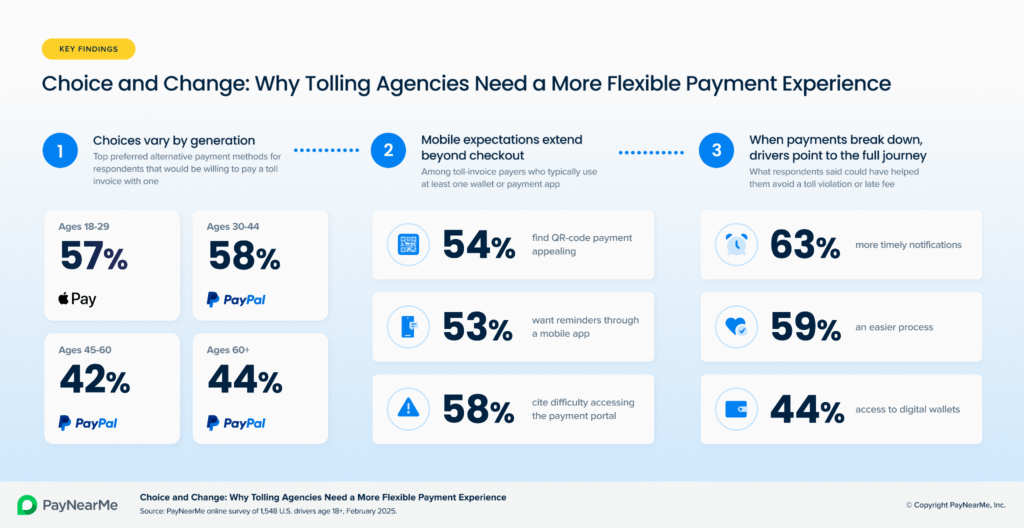
Among respondents ages 18–29, 57% say they would be likely to use Apple Pay to pay a toll invoice, compared with just 38% who say they would be likely to use PayPal. Among respondents ages 30–44, PayPal leads at 58%, compared with 31% for Apple Pay. PayPal also leads among respondents ages 45–60, with 42% saying they would be likely to use it compared with 36% for Apple Pay.
And interest doesn’t disappear among older respondents in the survey. Among respondents ages 60+, 44% say they would be likely to use PayPal to pay a toll invoice, while 34% say they would be likely to use Apple Pay.
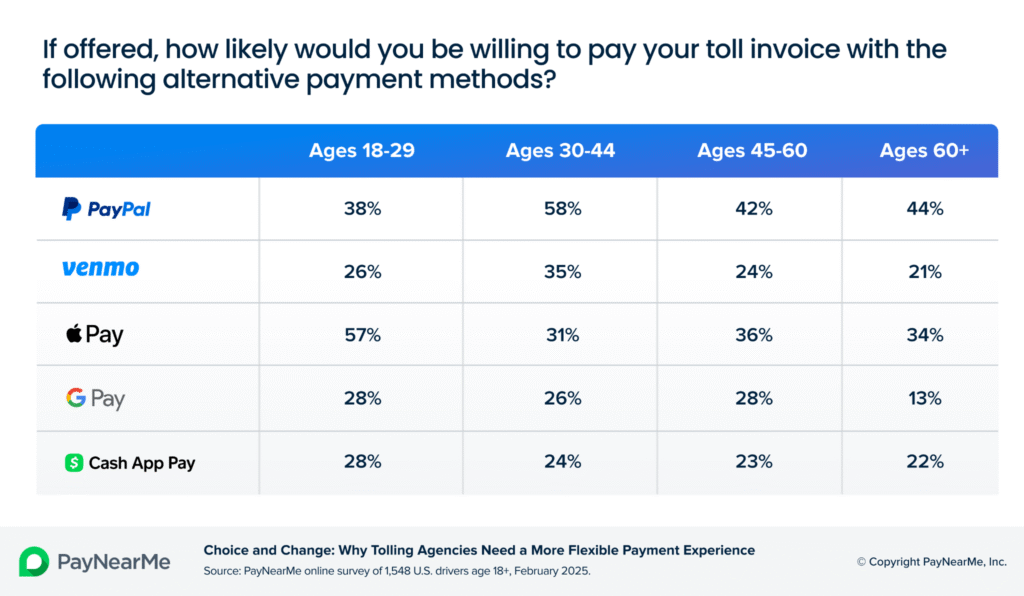
These findings do not tell us whether older and younger drivers are equally interested in digital payments overall. They show that within the group analyzed, preferences vary by age and there is no “winning wallet” across every generation.
For agencies, these differences reinforce the importance of a flexible payment mix rather than relying on any single method. A flexible mix can accommodate different preferences today, but the broader payment experience must also be able to evolve as consumer behaviors and payment technologies change without requiring agencies to repeatedly rebuild their payments stack.
That flexibility should extend beyond checkout. Offering the right payment methods has limited value if drivers struggle to receive the necessary information, access the appropriate payment flow or complete the payment using the mobile tools they already rely on.
Mobile toll payments: From reminders to payment completion
Before drivers can pay a toll, they must first receive information about the payment and find their way into the appropriate payment flow. That broader experience has direct financial and operational consequences for agencies. Friction at any of those steps can delay revenue, contribute to violations, generate service contacts and create operational work for the agency.
The survey suggests respondents are interested in mobile tools throughout the payment journey that can create a more seamless experience:
- 54% find the option to pay a toll invoice by scanning a QR code appealing
- 53% would like invoice reminders through a mobile app
- 45% would like reminders through their phone’s wallet
At the same time, 58% cite difficulty accessing a toll agency’s website or payment portal as a top frustration.
Taken together, these findings suggest that respondents aren’t only thinking about which methods they use to pay. They also express interest in mobile tools that provide a more direct path from notification to payment.
A smart QR code on a paper invoice, for example, can take a driver directly into a mobile payment flow instead of requiring them to search for an agency website or locate the appropriate portal. Mobile notifications can similarly bring payment information closer to the device consumers already use to manage other transactions.
For tolling agencies, this is where consumer experience and business performance intersect. A direct, mobile-friendly path to payment can support self-service and payment completion while reducing the avoidable support and exception work created when drivers cannot find or navigate the right payment flow.
When violations occur, drivers point to friction across the journey
Among drivers interested in using digital wallets and payment apps for tolls who had received a violation, respondents identified several factors they believed could have helped them avoid the violation or late fee:
- 63% say more timely notifications
- 59% say an easier payment process
- 44% say access to digital wallets
While these responses reflect consumers’ perceptions of what might have helped, they do not establish that any one of these changes would have prevented a violation. They do, however, reinforce the broader pattern: respondents point to communication, access and payment choice—not a single isolated problem.
For agencies, that distinction matters because unresolved payments affect more than customer satisfaction. They can mean delayed revenue, additional servicing activity, exception handling and avoidable violations. Improving one touchpoint without considering the others may simply move the friction elsewhere in the journey.
Putting payment preferences into practice
The analysis points to two practical areas for tolling agencies to consider as they adapt to increasingly mobile consumer behavior.
1. Offer a flexible mix of digital wallets and payment apps
Because stated interest varies by age and method, agencies should focus on offering a flexible mix rather than selecting one “winning” option.
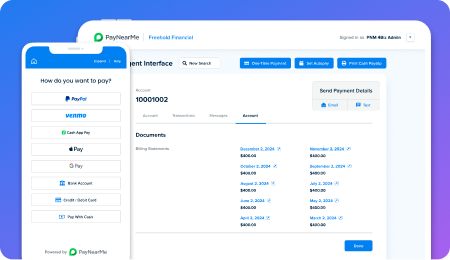
That mix may include digital wallets such as Apple Pay and Google Pay and payment apps such as PayPal, Venmo and Cash App, alongside traditional payment methods. It should also be able to evolve as consumer preferences and payment technologies change.
The goal is not simply to add more logos to the checkout screen. It is to give drivers meaningful choices among payment methods they know and trust.
2. Connect toll notifications to a simpler payment process
Digital wallets and payment apps provide limited value if drivers struggle to reach them. Agencies should consider how payment-due information, reminders, account access and payment can work together across the mobile journey.
Personalized payment links, smart QR codes and relevant mobile notifications can reduce the steps required to move drivers into a secure payment flow where their preferred methods are easy to find and use.
The objective is not to force every driver down the same digital path. It is to provide multiple connected paths that make it easier to move from knowing a payment is due to completing it. For agencies, a more direct journey can support self-service and payment completion while reducing avoidable service contacts and operational work.
The future of toll payments: An experience built to evolve
For tolling agencies, the opportunity is far larger than adding another payment method to the checkout screen. It’s about designing a payment experience that places a premium on choice and ease of use while being adaptable. Because the right payment mix won’t remain static.
Consumer behaviors will continue to change and new payment methods will emerge.
Payment Experience Management provides the framework for optimizing and continually improving the touchpoints that shape the payment journey—from notification and access through payment completion. This approach helps agencies meet consumers where they are today and adapt the payment mix and surrounding experience as expectations change.
The future of toll payments isn’t one wallet. It’s an experience flexible enough to accommodate whatever comes next.