Why Tolling Back Office Systems Need to Rethink the Total Cost of Acceptance
For tolling back office system providers, payments are often treated as a downstream function—something that happens after transactions are processed, accounts are updated and invoices are issued. But that perspective is becoming increasingly outdated.
As agencies demand faster implementations, stricter compliance and lower operating costs, back office systems are under pressure to deliver more value without adding complexity. And in that environment, payments are no longer just a cost center—they’re a strategic lever.
The most forward-thinking back office providers are starting to evaluate payments through a different lens: total cost of acceptance (TCA). This broader framework goes beyond transaction fees to account for the full operational, compliance and support costs tied to collecting toll revenue and reducing revenue leakage.
When viewed this way, payments become one of the most impactful areas for optimization and driving operational efficiency.
Payments are more than transaction fees
It’s easy to focus solely on transaction costs and processing fees when evaluating payment performance. But those line items only tell part of the story.
In a tolling environment, the real cost of accepting payments extends across multiple layers of the back office:
- Reconciliation and exception handling
- Compliance and regulatory overhead
- Customer support operations
- Payment method management
- Integration and maintenance costs
Each of these areas introduces friction, and in many cases, hidden expenses that compound over time.
For back office systems, these costs don’t just affect internal margins. They directly influence the value delivered to tolling agency clients. Higher operational costs ultimately get passed through—whether in the form of higher contract pricing or reduced service flexibility.
That’s why leading providers are shifting their focus from minimizing transaction fees to reducing the total cost of acceptance.
The operational burden behind toll payments
Back office systems sit at the center of the tolling ecosystem, orchestrating everything from transaction ingestion to account management and payment collection. That central role also makes them responsible for a significant share of operational complexity.
Payment-related workflows are a major contributor.
Managing numerous fragmented (and often dated) payment channels with manual reconciliation processes and inconsistent reporting structures creates inefficiencies that require additional staff time and resources. Even small gaps—like mismatched transaction records or delayed settlement visibility—can cascade into larger operational challenges.
For providers that support multiple agencies, these inefficiencies scale quickly.
Reducing operational overhead isn’t about eliminating support altogether. Back office providers still need to deliver high-quality service to their agency clients. But they do need to make that service more efficient by enabling smaller teams to handle the same or greater volume without sacrificing performance.
This is where a modern payments platform can make a measurable difference.
Compliance complexity is growing
Compliance has always been a critical consideration in tolling, but the requirements are becoming more demanding.
Back office systems must navigate evolving standards around payment security, data privacy and auditability. They also need to ensure transparency in how transactions are processed, recorded and reported, especially when working with government-run agencies that face heightened scrutiny.
Managing these requirements internally can be resource-intensive. It often involves ongoing updates to systems, processes and documentation, as well as coordination across multiple stakeholders. A fragmented payments infrastructure only adds to the burden and operational expenses.
By contrast, a unified payments platform that is built with compliance in mind can help reduce this overhead. Centralized reporting, standardized workflows and built-in security controls simplify the process of meeting regulatory requirements. For back office providers, that translates into lower compliance costs and reduced risk—both of which are highly valuable to agency clients.
Speed and flexibility are no longer optional
Tolling agencies are increasingly prioritizing speed to implementation. Whether launching a new system or upgrading an existing one, they want to get up and running quickly without lengthy integration cycles. Back office providers are expected to deliver on that expectation.
But integrating traditional payment gateways can slow things down. Custom builds, rigid architectures and limited payment method support often create bottlenecks that delay deployment timelines.
Flexibility is just as important as speed. Agencies want the ability to offer multiple payment options, adapt to changing user preferences and scale over time without major system overhauls. A modern payments partner should enable—not hinder—these goals.
That means offering configurable APIs, pre-built integrations and support for a wide range of payment methods, all within a single platform. The result is faster onboarding, easier customization and a more future-proof solution.
Improving support efficiency without sacrificing service
Customer support is a necessary and valuable component of tolling operations. Drivers need help resolving issues, updating payment methods and understanding their accounts.
Back office systems are under pressure to reduce leakage and improve customer service with fewer resources. By reducing the overhead required to deliver support, they can improve efficiency while continuing to meet agency expectations.
Payment-related inquiries make up a significant portion of support volume. Failed transactions, unclear payment statuses and limited self-service options all contribute to higher call and ticket volumes.
By improving the payment experience and choosing a payments partner that integrates valuable support tools, back office systems can reduce these friction points.
Features like real-time payment visibility, intuitive user interfaces and flexible payment options empower drivers to resolve issues on their own. At the same time, better support operations tools like interactive voice assistants (IVA) give support teams faster access to the information they need with less manual intervention.
The result is a more efficient support operation that requires fewer resources to maintain.
A better approach: optimizing total cost of acceptance
When back office providers take a holistic view of payments, the opportunity becomes clear.
Reducing the total cost of acceptance isn’t about optimizing a single metric. It’s about improving performance across the entire payment integration and acceptance lifecycle:
- Lowering operational overhead through automation and consolidation
- Reducing compliance complexity with built-in controls and reporting, plus working with a payments partner who can assume part of the compliance responsibility
- Accelerating implementation with flexible, scalable integrations
- Improving support efficiency by enhancing the customer payment experience with sophisticated interactive tools
Each of these improvements contributes to a lower overall cost structure—one that can be passed on to tolling agency clients as a competitive advantage. But achieving this requires the right partner, particularly one focused on Payment Experience Management.
How PayNearMe supports modern tolling back office systems
PayNearMe’s PayXMTM platform is designed to help back office providers address the full scope of payment-related challenges—not just transaction processing.
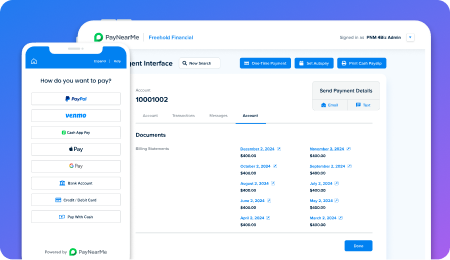
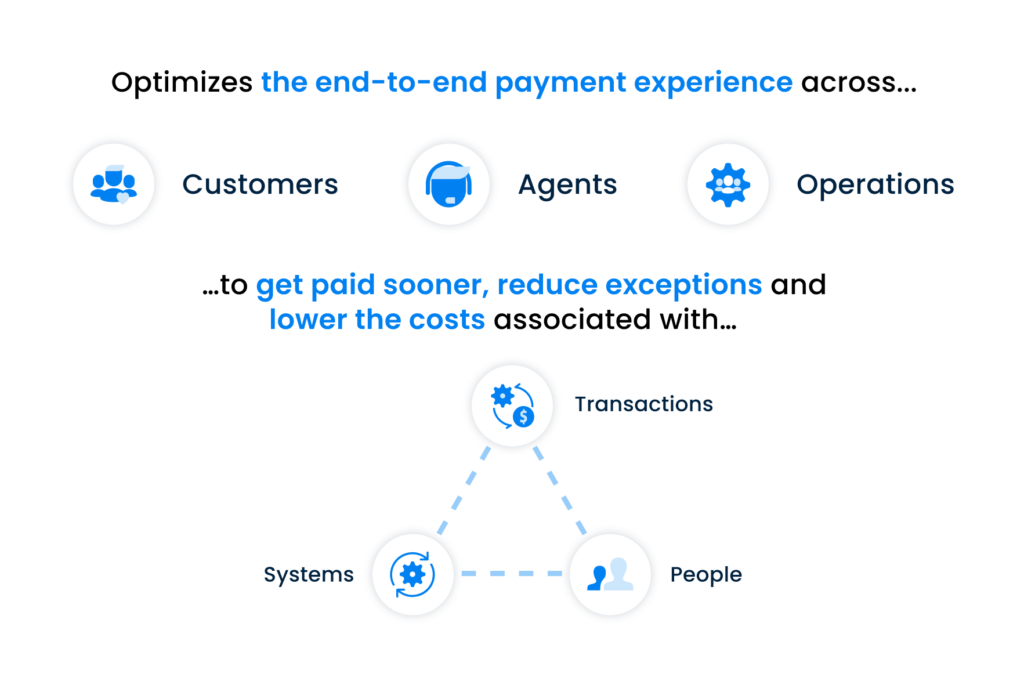
By unifying multiple payment methods and channels into a single platform, PayXM reduces the complexity associated with managing disparate systems. This consolidation simplifies reconciliation, improves reporting accuracy and lowers operational overhead.
From a compliance standpoint, PayXM provides built-in security and standardized workflows that make it easier to meet regulatory requirements. Centralized data and audit-ready reporting further reduce the burden on internal teams.
The platform’s flexible architecture supports fast, efficient integrations, enabling back office providers to onboard new agency clients more quickly. Configurable APIs and pre-built components allow for customization without the need for extensive development work.
On the customer experience side, PayXM offers intuitive, self-service payment options that reduce friction for drivers. Real-time updates and clear payment visibility help minimize confusion and lower support volume.
Together, these capabilities help back office providers reduce their total cost of acceptance while delivering a better experience to their tolling agency clients.
Turning payments into a competitive advantage
As tolling continues to evolve, back office systems are being asked to do more than ever before. They must balance revenue assurance, operational efficiency, regulatory compliance, and customer experience—all while keeping costs under control. Payments sit at the intersection of all three.
By rethinking how payments are managed and measured, back office providers can unlock meaningful efficiencies that extend across their entire operation. The total cost of acceptance framework provides a practical way to identify and capture those opportunities.
With the right partner, payments can shift from a source of complexity to a driver of value. And for back office systems looking to differentiate in an increasingly competitive market, that shift isn’t just beneficial—it’s essential.